

Learn how to make a book with I/O Color.
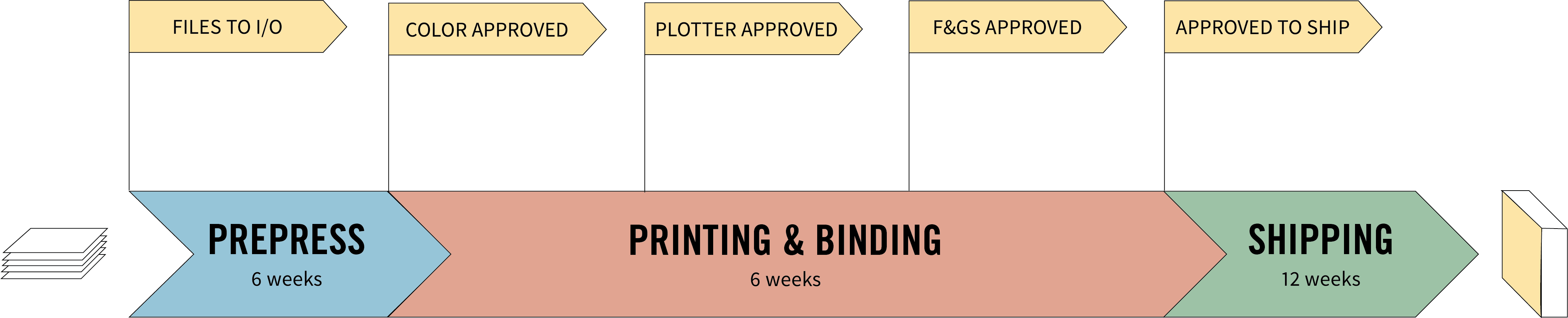
After an initial discussion to establish project goals, files are sent to I/O Color. Final specs are used to generate an accurate quote for estimated prepress, printing, and shipping costs.
Final packaged InDesign files, linking to hires images and fonts.
For more detailed information, read our File Delivery Specifications below.
Files are profiled according to project specs and a set of Epson proofs is created for each image in the book. Clients review, mark, and approve color proofs, going through as many rounds of corrections as needed.
The approved Epson proofs are sent to the printer to use as a color guide while on press, ensuring images are reproduced as accurately as possible.
Print ready files and the approved proofs are sent to the printer. A low resolution printed proof of the book is created and sent for approval before proceeding to print the full run of books.
Once printing has been completed the folded, collated, and trimmed sheets (F&Gs) are sent out for final review and approval to bind.
Completed books are either shipped by air directly from the factory or transferred to a freight forwarder who manages the bulk shipment via ocean freight through final delivery.
Please use the following guidelines when submitting your files to I/O Color. Download a PDF of these guidelines here.
Files can be delivered on disc or drive to our office in Seattle at the address below. Please note, if your files are large we recommend this method.
I/O Color
929 N 130th Street
Suite 8b
Seattle, WA 98133
Alternatively, files can be sent electronically by WeTransfer. Files larger than 2GB may need multiple transfers, or contact us for a link to our FTP site for uploading files.
A non-comprehensive list of terms you may encounter when working with I/O Color.
CMYK: The four standard inks used in a color printing press: (c)yan, (m)agenta, (y)ellow, and blac(k).
co-publication: A publishing agreement wherein a publisher purchases copies of a book up front, typically paying 20 to 25 percent of the retail price.
colophon: A statement containing information about a book’s materials and production, such as the name and location of the printer and the paper type and typefaces used. This may appear on a separate page of the book, or be included on the copyright page.
color proofs: Printouts of book pages in full color that approximate how each page will look in the final book on the chosen paper. Color proofs are reviewed to determine necessary image adjustments.
copyright page: The page that includes a book’s publication information, printing history, cataloging data, ISBN, and copyright notice. US Customs requires books to include the country of manufacture.
design: The general style of representative elements in a book, such as text and display typefaces and sizes, margins and page structures, and other unique aspects or decorative devices that allow for the layout to be developed.
distribution: An agreement wherein a book distributor or publisher takes a title on a consignment basis to make it available to the book trade. The publisher pays roughly 25 percent of the retail price in single annual payments.
endpapers/endsheets: A decorative leaf of paper at the beginning and end of a book, usually fixed to the inside of the cover to help hold the interior pages in place.
fifth color: An ink added to the press above and beyond the usual four (see CMYK), typically custom mixed for each use. Metallic, fluorescent, and other specialty inks are printed this way.
flexibind: A type of binding with a flexible cover that is thicker and more durable than a typical paperback.
folio: The page number printed on the page. This term can also refer to the format and size of a book.
font vs. typeface: A typeface is a specific overall design of type, while a font is a singular style within that design. Helvetica Bold Condensed is a font; Helvetica is a typeface.
gutter: The adjacent inner margins of facing pages when a book is open. Gutter can also refer to the space between columns of type.
half-title page: The first page of a book. Generally, only the main title of the book is printed on the half-title page.
head and tail bands: Narrow bands of cloth that hide and protect the glued top and bottom of the book block at the spine.
leading: The vertical space between lines of text; also called line spacing.
paper cut-off date: The date by which the printer needs to order paper and other materials for the book, and therefore the date when the full print run should be finalized.
PLC: Printed and laminated case; often a hardcover with no jacket.
plotter proof (sometimes called an ozalid or blueline): A rough printout of the entire book provided by the printer for an ultimate review of the book.
recto/verso: When looking at a two-page book spread, the recto is the page on the right and the verso is the page on the left.
signature: A printed sheet after being folded to form a group of pages which are then bound together. All signatures contain page counts in multiples of four.
spread: Two pages of a book (a recto and a verso) viewed side by side.
tip-in (interior): A page or pages manually placed and glued into the book.
tip-on (cover): A piece of paper smaller than the cover, glued in place.
title page: The first right-hand page at the beginning of a book, following the half-title page. The title page shows the title and subtitle of the book, the editor and author’s names, and the publisher’s name and location.